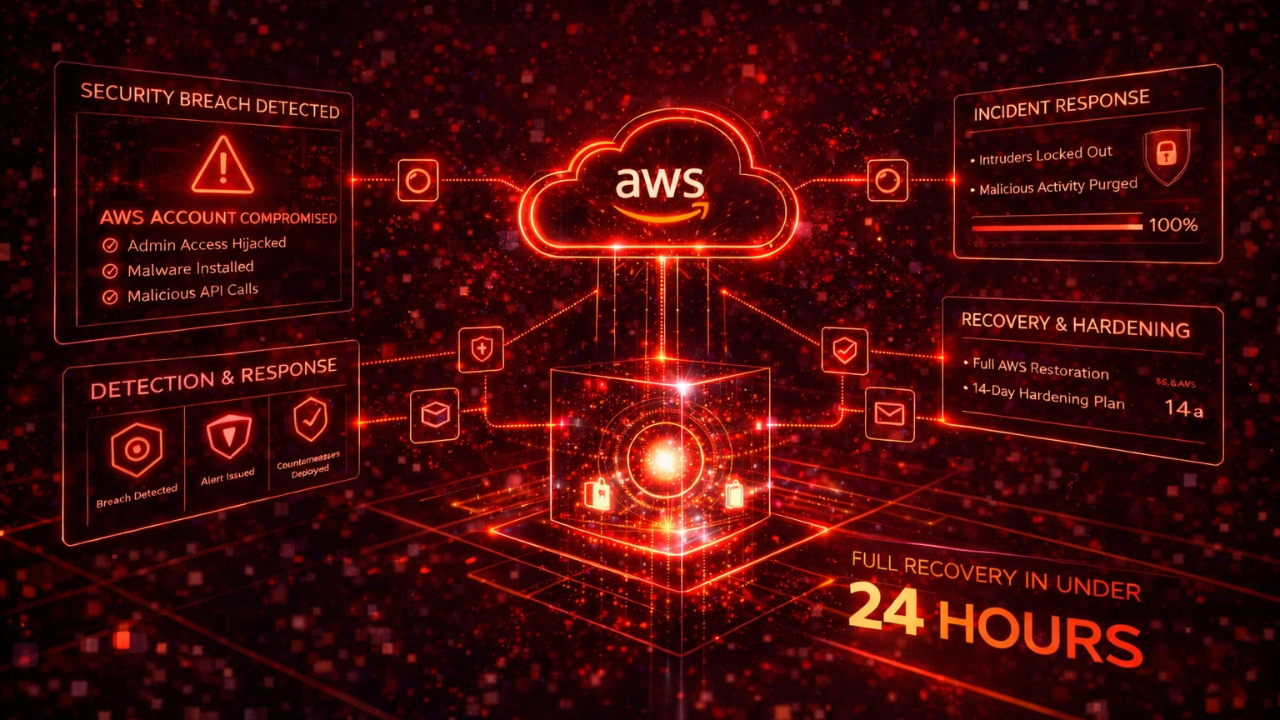
AWS estimated 4 days. We restored full operations in under 24 and hardened the environment in 48 — a protocol later presented at AWS re:Inforce. This is the playbook, with the actual IAM policies, CloudTrail queries, and S3 lockdown patterns.
An executive advisory firm's AWS root account was compromised — attacker launched a quarter-million-email abuse campaign, uploaded malware to S3, and got the account suspended. Tech Stack Playbook's 48-hour incident response restored operations in under 24 hours against AWS's 4-day estimate.
The lockdown protocol that followed — 14 steps, from root-credential elimination to JWT-gated API re-architecture — is below. Every step includes the specific controls we'd ship today. Presented at AWS re:Inforce as a reference framework for developer-led incident response.
01 / ANATOMYHow the Breach Actually Unfolded
The breach followed the oldest playbook in cloud security: unprotected root credentials, no MFA, broad blast radius. What made it memorable was the speed of escalation — from first unauthorized API call to full account suspension, under four hours. Senior engineers have seen plenty of security engagements, but this one was instructive: every step the attacker took exploited a default that should never have been the default.
The tell at Stage 02 was volume: legitimate SES usage for this workload averaged ~400 emails per day. A CloudTrail lookup across a 4-hour window surfaced the divergence immediately — and it's the first query we run in any modern incident response engagement:
# Surface SES API anomalies in the last 4 hours — volume + source IP
aws cloudtrail lookup-events \
  --lookup-attributes AttributeKey=EventName,AttributeValue=SendEmail \
  --start-time $(date -u -d '4 hours ago' +%s) \
  --query 'Events[].{Time:EventTime,User:Username,IP:CloudTrailEvent}' \
  --output table \
  | awk '/sourceIPAddress/ {print $NF}' | sort | uniq -c | sort -rn
02 / TIMELINEThe 48-Hour Recovery Arc
Drag the marker to scrub through the 48 hours. Each checkpoint is a real decision point — where most incident responses either compound or contain.
Platform back online. All client-facing APIs serving traffic. Root credentials retired, initial MFA controls live, S3 bucket policies audited and locked. 75% ahead of AWS's stated recovery estimate.
03 / PROTOCOLThe 14-Step Security Lockdown
With operations restored, the real work began: hardening the environment so the same class of breach couldn't happen twice. Click into any step to see the specific controls, policies, and code we'd ship today. This protocol pulls directly from lessons learned on our multi-account AWS governance work and adjacent DevSecOps engagements.
The root account is not an operator account. First 60 minutes: rotate the root password, force-retire every access key under root, enable MFA (hardware preferred), and enforce an SCP that denies root usage for anything except the handful of tasks that genuinely require it (billing signup, account close, root-only service endpoints).
{
  "Version": "2012-10-17",
  "Statement": [{
    "Sid": "DenyRootUserActions",
    "Effect": "Deny",
    "Action": "*",
    "Resource": "*",
    "Condition": {
      "StringLike": {
        "aws:PrincipalArn": "arn:aws:iam::*:root"
      }
    }
  }]
}
Long-lived IAM users are an anti-pattern in 2026. Every human operator gets federated access through IAM Identity Center (formerly AWS SSO) with short-lived credentials. Every remaining IAM user gets deleted or disabled. Every long-lived access key gets rotated to a role-based assumption pattern.
# Find every active long-lived access key older than 90 days
aws iam list-users --query 'Users[*].UserName' --output text \
  | tr '\t' '\n' \
  | xargs -I {} aws iam list-access-keys --user-name {} \
      --query 'AccessKeyMetadata[?Status==`Active`]' \
      --output table
The attacker had AdministratorAccess because the compromised identity had it. Rewrite every policy to grant the minimum set of actions on the minimum set of resources. Restrict IAM creation itself to a small, named admin group — protected by both MFA and an SCP boundary.
Fastest path: use IAM Access Analyzer's policy generation to diff intended vs. actual privileges, then prune.
Enable Block Public Access at the account level, not just per-bucket. Audit every bucket policy for "Principal": "*" and kill it on sight. Every object upload triggers a malware scan (GuardDuty Malware Protection or an S3 EventBridge → Lambda → ClamAV pipeline).
aws s3control put-public-access-block \
  --account-id $AWS_ACCOUNT_ID \
  --public-access-block-configuration \
    BlockPublicAcls=true,IgnorePublicAcls=true,\
BlockPublicPolicy=true,RestrictPublicBuckets=true
Databases move to private subnets with no public ingress. API Gateway endpoints enforce JWT authorization at the edge, validated against a managed auth layer (Cognito or equivalent). Client data is never served through an unauthenticated path.
Sandbox SES. Explicit sending authorization policies. Configuration sets with per-send quotas and bounce/complaint tracking. Anomaly detection on send volume (in this case, anything above 2× rolling 7-day baseline pages on-call immediately).
Organization-wide CloudTrail, multi-region, log file validation enabled, delivered to a dedicated log-archive account with S3 Object Lock in compliance mode. If an attacker can rewrite your audit trail, you don't have an audit trail.
Continuous threat detection via GuardDuty. Findings aggregated in Security Hub across every account. EventBridge rules route high-severity findings to PagerDuty with a documented on-call rotation. No silent findings.
Customer-managed KMS keys for every tier of sensitive data. Key policies scoped to specific IAM principals. Automatic annual rotation. Client transcripts, PII, and payment data never stored in plaintext anywhere.
No plaintext secrets in env vars, config files, or repos. Every credential lives in Secrets Manager with Lambda-backed rotation (we default to 58-day cycles to stay well inside the 60-day quarterly audit window). Applications pull at runtime, not at deploy.
Every infrastructure change lands through Terraform with peer review. Console access is read-mostly. Drift detection runs nightly. This is the same IaC-first pattern we implemented during our multi-account AWS modernization — it pays compounding dividends the minute an incident happens.
AWS WAF in front of every internet-facing API with managed rule groups (OWASP Top 10, bad bots, known-bad IPs) and custom rate-limit rules scoped per authenticated identity.
The first IR engagement is always the most expensive, because there's no runbook. We left the client with documented runbooks for root compromise, data exfiltration, SES abuse, and account suspension — plus quarterly tabletop drills that test them.
Security is never done. Quarterly reviews walk the full attack surface, audit new IAM policies added since last cycle, re-validate that GuardDuty/Security Hub have no stale findings, and update the threat model as the platform evolves.
Client coaching transcripts — private strategy sessions with nine- and ten-figure entrepreneurs — had been stored in publicly accessible S3 buckets and served through unauthenticated API endpoints. The breach was the forcing function. The lockdown was the product.
04 / ARCHITECTUREBefore & After — What Actually Changed
The post-lockdown architecture isn't exotic. It's what a security-first AWS account looks like when every default has been explicitly hardened instead of inherited.
05 / OUTCOMESWhat Shipped
Full platform restored vs. AWS's 4-day estimate — minimizing downtime for ultra-high-net-worth clientele.
All hardening steps implemented and validated within 48 hours of initial engagement.
Previously public client data locked down with KMS envelope encryption and JWT-gated delivery.
Protocol later presented at AWS re:Inforce as a framework for developer-led incident response.
Stack
Foundational identity service powering every role, policy, and resource boundary.
Federated SSO replacing every long-lived IAM user with short-lived credentials.
Managed identity provider issuing JWTs validated at the API edge.
Edge-layer OWASP rules and per-identity rate limiting on every public API.
Continuous threat detection and malware scanning across the entire account.
Cross-account findings aggregated into a single security posture dashboard.
Org-wide audit log delivered to a locked-down archive account with Object Lock.
Real-time logs, metrics, and alarms across every account and service.
Event bus routing GuardDuty and Security Hub findings to on-call workflows.
Customer-managed envelope encryption for transcripts, PII, and payment data.
Runtime credential storage with Lambda-backed 58-day automatic rotation.
Account-level public-access controls plus per-object malware scanning.
Every infrastructure change shipped through peer-reviewed IaC. No click-ops.
06 / TAKEAWAYWhy Developer-Led IR Beats a Ticket Queue
AWS's 4-day estimate isn't a judgment on AWS — it's a function of the generic queue every support request sits in. Developer-led incident response is faster because the people triaging the breach are the same people who can rewrite an SCP, ship a JWT middleware, and redeploy infrastructure as code before lunch. That's the difference between a ticket and a response team. It's also the argument for having security-minded engineers embedded before anything goes wrong, not after.
If you're reading this and thinking about your own root account MFA status — that's the right instinct. Go check right now. We'll wait.
Need an incident-response-ready AWS foundation?
We partner with enterprise teams to design, build, and ship production-grade cloud systems that are secure-by-design from day one — so breaches are contained, not catastrophic.
Book a strategy call